Morton Kunstler (American 1927 – 2025) ( aka Mort Kunstler ) Lincoln Memorial
Gouache on board, 12 x 12 inches/signed lower right
Before reading further, take a moment with this painting — notice what it stirs in you.
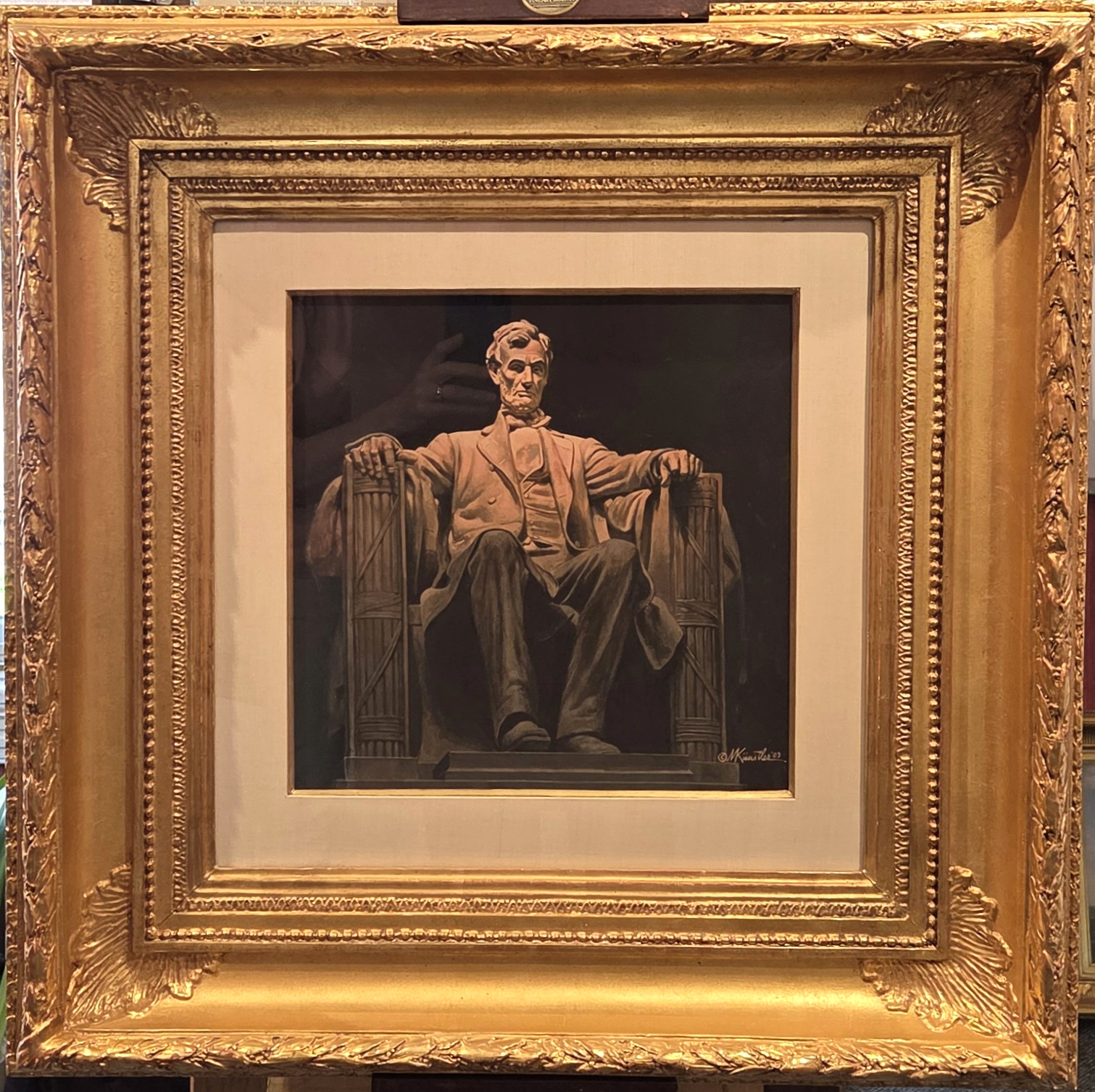
Click image to zoom
Künstler was born in the Coney Island section of Brooklyn, New York in 1927. A young Kunstler was encouraged by his father, who was an amateur artist and his mother, a teacher, who would take a young Kunstler to the Brooklyn Museum on Saturday mornings for children’s art classes. During his childhood, Kunstler had suffered from illness, but with the help of his father encouraging him in the physical activity of sports, he regained his physical stamina. In 1943, at fifteen, Künstler graduated from high school and enrolled at Brooklyn College, where he excelled in athletics -- he was Brooklyn College’s first four-sport letterman (diving, basketball, track, and football). After three years there, he attended University of California, Los Angeles (UCLA) on a basketball scholarship, but returned to New York City after his father suffered a heart attack.
After his return to New York, Kunstler enrolled in the art school at Pratt Institute on a basketball scholarship facilitated by his former Brooklyn College coach. In 1949, Künstler traveled to Mexico City, where he spent his time cycling throughout Mexico with their art supplies to capture scenes from south of the border. He painted in watercolor and strove to paint at least one picture a day, which sometimes served as payment for his room and board. After graduation from Pratt in the early 1950s, Kunstler began his art career as an illustrator for books and prominent magazines of that time -- Sports Afield, Boys’ Life, The Saturday Evening Post, Outdoor Life, Men’s Adventure and True Magazine.
During the 1960s, the New York advertising agencies and publishers were increasingly moving towards television rather than print media, and print media was starting to replace illustration work by artists with color photography. However, Kunstler was still a favorite of many advertisers/publishers and was kept very busy. He moved, with his family, to Cuernavaca, Mexico in 1960, completing commissions for illustrations for magazines and books and sending the finished work to New York City. In 1963, Kunstler and family moved back to the United States and settled in Oyster Bay, New York on Long Island Sound. In 1966 Kunstler received an assignment for National Geographic to depict the early history of St. Augustine, Florida followed by another National Geographic assignment on the discovery of San Francisco Bay. He learned how to conduct the in-depth research required to produce historically accurate scenes, and adopted this methodology, along with site visits, for the final work. These practices would serve him well later in his career.
The 1970s continued to be a very busy time for Kunstler. At this time, major magazine commissions, e.g. Newsweek, Good Housekeeping, and MAD Magazine, along with work for consumer brand advertising agencies were becoming a large part of his work. In addition, during the 1970s, Kunstler was hired by major motion picture companies to produce movie posters for some that era’s block-buster movies -- The Poseidon Adventure (1972) and The Hindenburg (1975), Go Tell the Spartans (1978), The Taking of Pelham One Two Three (1974), and The Golden Voyage of Sinbad (1974). In 1977, Kunstler had his first solo exhibition and was on his way to becoming a well-known historical painter. In 1979, he became the became the official Space Shuttle artist for NASA’s and the Rockwell International Corporation’s space shuttle "Columbia."
1981 saw the end of his illustration work and his concentration on historical paintings; first Western scenes, but after he was commissioned to paint a scene for the CBS mini-series The Blue and the Gray in 1982, his primary focus became the men and battles of the Civil War. In 2010 Kunstler was commissioned to paint Washington Crossing the Delaware, a more realistic version of Emanuel Leutze’s iconic painting of the same name. Kunstler continued to paint scenes of the Civil War and the American Revolutionary War until his retirement in 2019. He died in 1925.
High auction record for this artist: $125,000.