Xanthus Russell Smith (American 1839 - 1929) Still-life of Apples, Chestnut Burs and Pear
Oil on canvas, 15.5 x 19 inches/Signed lower left
Before reading further, take a moment with this painting — notice what it stirs in you.
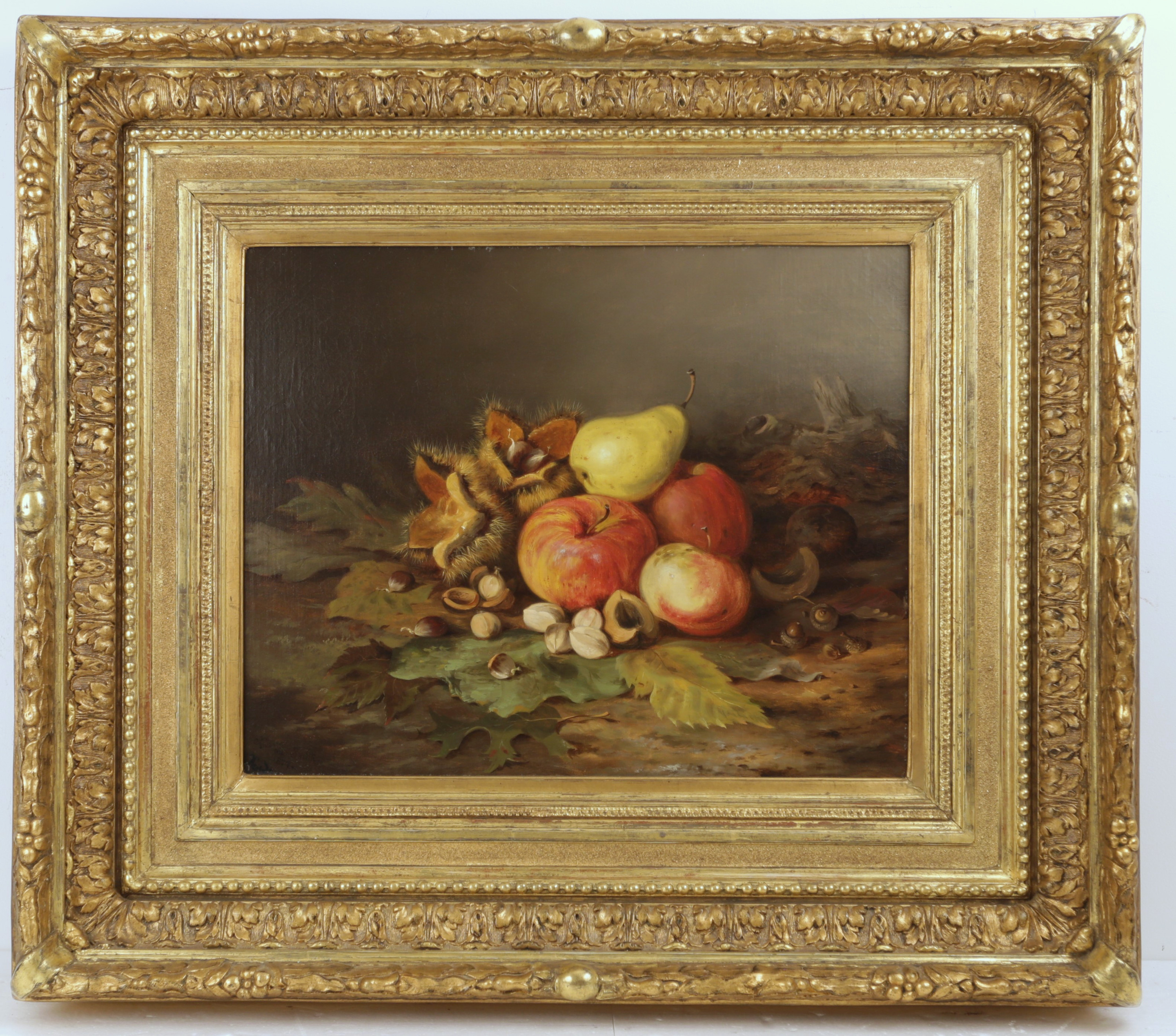
Click image to zoom

Smith was born to artists Russell Smith and Mary Priscilla (Wilson) Smith. Young Smith was given art instruction by his mother and father. In 1851 he traveled with his parents and sister Mary to Europe where he would study the art he saw while there. In 1852, after the family returned to Philadelphia, Smith set about painting in earnest. In 1854, at the age of 15, he received his first commission—a landscape of a neighboring property to “Edgehill,” the Smith family home outside of Philadelphia. Smith exhibited a landscape of Edgehill at the Pennsylvania Academy of the Fine Arts in 1856. During the American Civil War, Smith served as a clerk to Commander Thomas G. Corbin on the Wabash, the flagship of Rear Admiral Samuel Dupont’s South Atlantic Blockading Squadron. During his service, he made drawings of ships which became popular among DuPont and he tother officers, and he received commissions from them to paint their ships and other marine vessels. In 1864 Smith reluctantly resigned his commission due to serious illness after his father wrote to Commander Corbin requesting that he be allowed to return to Edgehill. In 1868 he received a commission from Charles Rogers, president of the Tradesman Bank in Philadelphia, followed by a commission from Philadelphia art dealer James S. Earle. Civil War subjects were in demand, and between the end of the war and 1876 Centennial Smith was to seal his reputation as America’s foremost painter of Civil War scenes. Smith had a studio at Edgehill and also maintained a studio on Chestnut Street in Philadelphia for many years. He made a trip to Mount Desert Island, Maine, in 1877, and later bought a summer home on Casco Bay. In the early 1880s, Smith painted European landscapes—probably based on sketches that his father had made during there travel there in 1851. After 1876, his brushwork became looser and more painterly, evolving from his earlier, more finely detailed technique. After 1900 Smith focused more on portraiture and genre. Smith exhibited at the Pennsylvania Academy of the Fine Arts (1856-87) and Vose Galleries (Boston, 1879).