
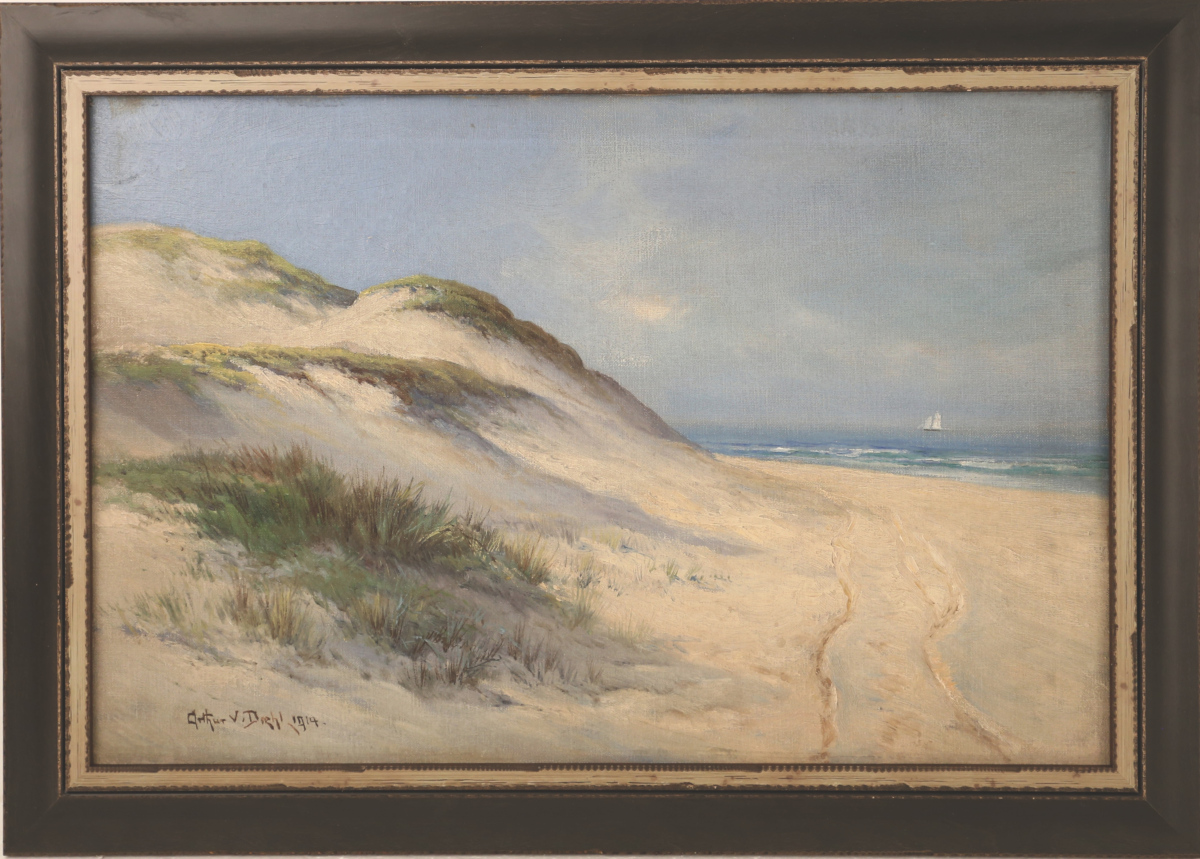
Unique among artists of the late 19th to early 20th centuries; there is still no artist like Arthur Vidal Diehl in the 21st century. Variously described as an art prodigy, “champion speed painter of America,”, showman, musician, and composer, he was truly a marvel of his time. [1, 2, 3, 4]
Arthur Vidal Diehl Bonaparte was born at London, England in 1870, the son of German-born Louis Vidal Bonaparte Diehl, known as Louis Diehl, director of the Royal London Orchestra and Alice Georgina Mangold Diehl, a pianist, and a writer of romance novels. As you may have surmised from his surname “Bonaparte,” his great-grandfather was the French Emperor Napoleon Bonaparte; his great-grandmother was a beautiful German actress known as Madame Diehl. His given name “Arthur” is after the legendary king Arthur of Wales. Interesting already. [4, 5, 6]
Diehl was educated at Crespigny House School at Aldeburgh on the Suffolk coast of England. Although he had inherited musical ability from his mother and his father, who was a violinist, his interest was in painting and he spent many hours copying works at the National Gallery and British Museum. However, when he was about 15 years of age, his mother took him to see Sir Frederic Leighton, president of the Royal Academy, and according to Diehl, they showed him two of his sketches and after studying one of them, Sir Leighton simply stated that ‘I don’t know how the boy did the sky. I couldn’t do it myself.’ He pronounced Diehl a “genius” and recommended that the boy be sent to Italy to study. Diehl had taken some study at Heatherly’s and Calderon’s in London and this was followed by a trip to Milan, Italy where he studied with Salvatori Luigi Stefani. The young Diehl spent two years there continuing to copy paintings in museums, and instead of returning to England to attend Oxford, he spent two years travelling around Europe. [1, 4, 6]
In 1886, probably while Diehl was still in Europe, he painted a picture of the 'The Cross Keys', a tavern in Aldeburgh where he had attended school. He had never relied much on sketches or photographs to help him remember details. His approach was to imprint every relevant detail on his mind through a process he called "absorbing," a skill he had honed as a child Perhaps the young Diehl had a longing for England while traveling about on the continent and painting the old tavern from scenes “stored in his brain” offered a comforting connection with home. Diehl would later claim what others surmised, that he had a photographic memory. He remarked, in 1909, to Charles Battell Loomis, a writer for “Success Magazine & the National Post” that “Any landscape that I have once seen, and in which I was interested I can reproduce.” [1, 4]
By the late 1880s, Diehl was back in London and in 1889, at age 19, his painting “The Quay at Aldeburgh” was accepted for exhibition at the Royal Academy and sold for 100 pounds! The young man was on a path to success as an English artist. However, in 1893, he immigrated to New York with his wife (unfortunately, she died shortly after their arrival). One wonders if he was aware of the Panic of 1893 which gripped the United States at that time, resulting in bank, business and railroad failures and hardships for the citizenry. According to Diehl, after his arrival, although he was painting “good pictures and selling them” through a dealer, he still needed money...fast! [4, 7]
His dealer had mentioned that a bigger art house, to which he furnished canvases, was complaining that was not enough variety in what was being suppled. Diehl told him that he could provide 12 different paintings in five days and he did! Upon delivery to his dealer, and to prove to that he did indeed paint all 12 in five days and did not take from “reserves” he had in his studio, Diehl painted a “good” painting right before his dealer’s eyes. This led to a 14-year contract with the larger New York house and he would go on to turn out an average of 10 paintings every day until circa 1909. He was able to do this primarily because of his ability to paint from memory and the speed at which he was able to produce a good painting. Diehl firmly believed that it is practice and not time that is needed to produce a good oil painting. [4, 7]
Diehl remarried in 1898 and moved to New Jersey. His new wife had been in the theatre and she introduced her husband to the famous actors John and Lionel Barrymore. For a short time, Diehl acted with their touring company. During his time in New Jersey, Diehl moved around a bit and had studios variously at Englewood cliffs (1905-09), then Lakewood and Asbury Park (1909-13), and Leonia, New Jersey. [4, 8]
Although Diehl was a landscape painter, he did not paint out of doors -- he was a studio painter. And he made the most of it. With his outgoing personality and a bit of the showman, he became known for his own “shows” at his studio. There he would turn out a picture in a matter of minutes, all the while talking to his audience, occasionally taking a moment to perform a sleight of hand trick, enthralling his audience with an expertly painted scene, plucked from his brain, which was more often than not, purchased by one of his delighted audience members. [7]
Diehl had said that it was his idea “to open a public studio where I could work and where people were free to come and go as they pleased. It was a novelty then because artists usually painted in secret and only brought out their work for show after it was finished. Because it was such a novelty, my place was crowded. I had not a moment to myself. In fact, very often I could not get time enough to eat properly.” Diehl, his third wife (his second wife had died in 1903 and his family first came to Cape Cod for the summer of 1912, and later lived at Truro and Sandwich, finally settling at Provincetown. He often returned to England Diehl also wanted to create as many genuine works of art during his life as he possibly could. It was important to him to get “the real thing”, into the homes of families who have known only photographs and printed copies. [4, 5]
His ability to paint quickly from memory, yet maintain excellence in perspective, strong and true color, to produce a thoroughly interesting picture did not sit well with the artists of the Provincetown art colony. They believed that he “prostitutes his art.”. Diehl himself recognized that it was commercial and he made a business of it. No, it did not follow the normal model of “for art’s sake” that ruled other artists if the time, but he was very good at what he did. It was mentioned in the 2007 “Quite A Big Deal” exhibition catalog that “Regardless of how fast Diehl’s pictures were painted, they reveal a finely tuned sensitivity to light and atmosphere and convey a strong sense of place.” [2, 4, 7]
Newspapers of the times remarked that Diehl was “able to produce up to twenty-five paintings in a day which he always sold direct and never to dealers. Diehl was always completely indifferent to price and artistic reputation and painted voluminously as the only way to assure an income for his family.” As long as he had an audience, he sold paintings – good ones at that! Arthur Vidal Diehl died at, Fall Rivers, Massachusetts in 1929. [6]
Written by Joan Hawk, Researcher and Co-Owner Bedford Fine Art Gallery, July 22, 2026.
Use only with the permission of Bedford Fine Art Gallery.
References:
- https://archive.org/details/sim_success-magazine-the-national-post_1909-05_12_180/page/299/mode/1up?q=diehl (accessed 04/21/26.)
- https://newspaperarchive.com/bridgeport-evening-farmer-sep-15-1916-p-11/ (accessed 04/25/26.)
- Showman with a Paintbrush: The Life and Art of Arthur V. Diehl (accessed 04/21/2026).
- http://www.tfaoi.com/aa/7aa/7aa808.htm (accessed 04/21/2026).
- https://newspaperarchive.com/boston-sunday-post-jul-25-1915-p-4/ (accessed 04/21/2026).
- Suffolk Artists - DIEHL, Arthur Vidal accessed 4/26/26
- https://newspaperarchive.com/boston-post-aug-23-1919-p-5/ (accessed 04/21/2026).
- Gerdts, William H., 1990, Art Across America, Vol. 2, pg. 1915, Cross River Press, Ltd.