
The most honest art gallery in the world.
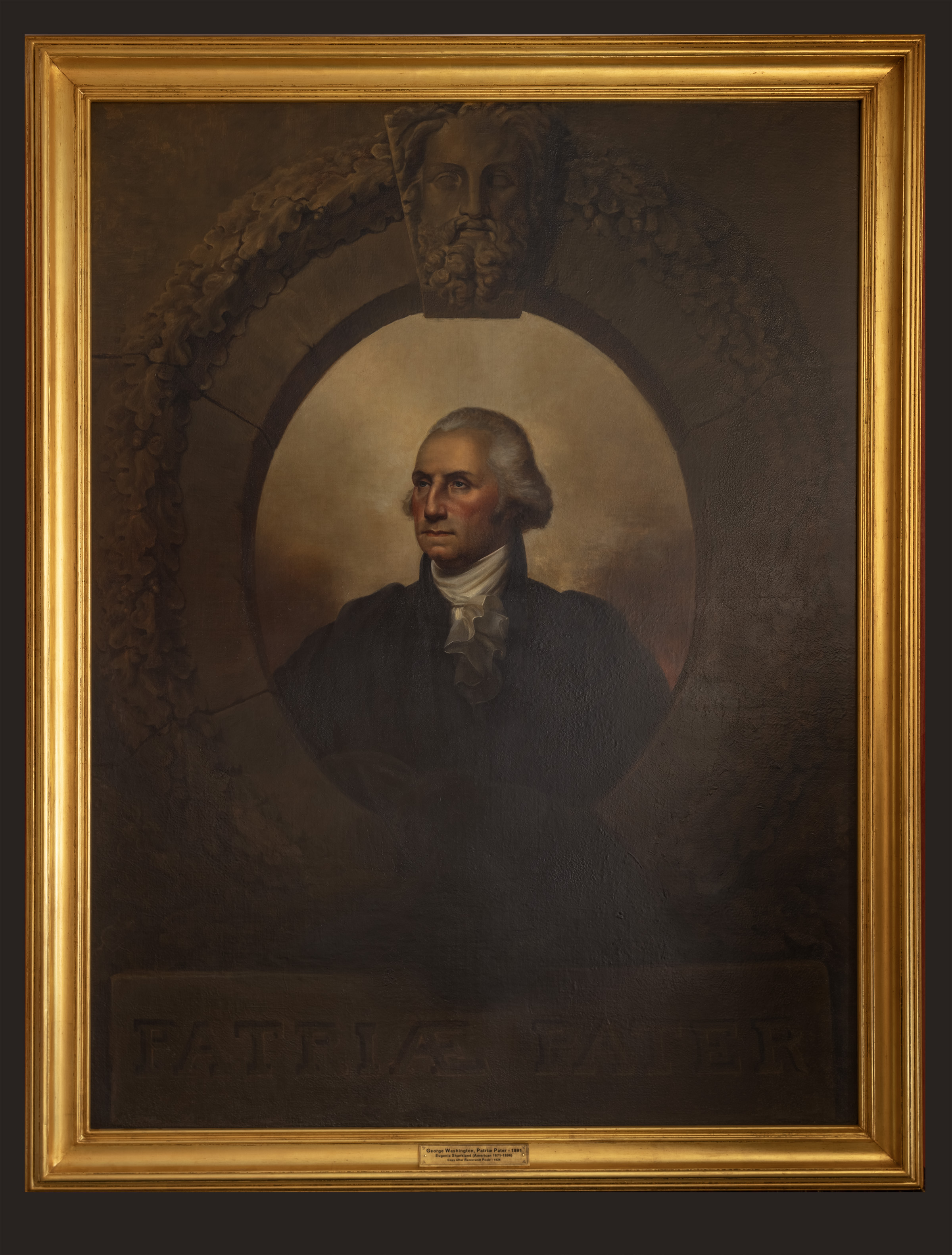
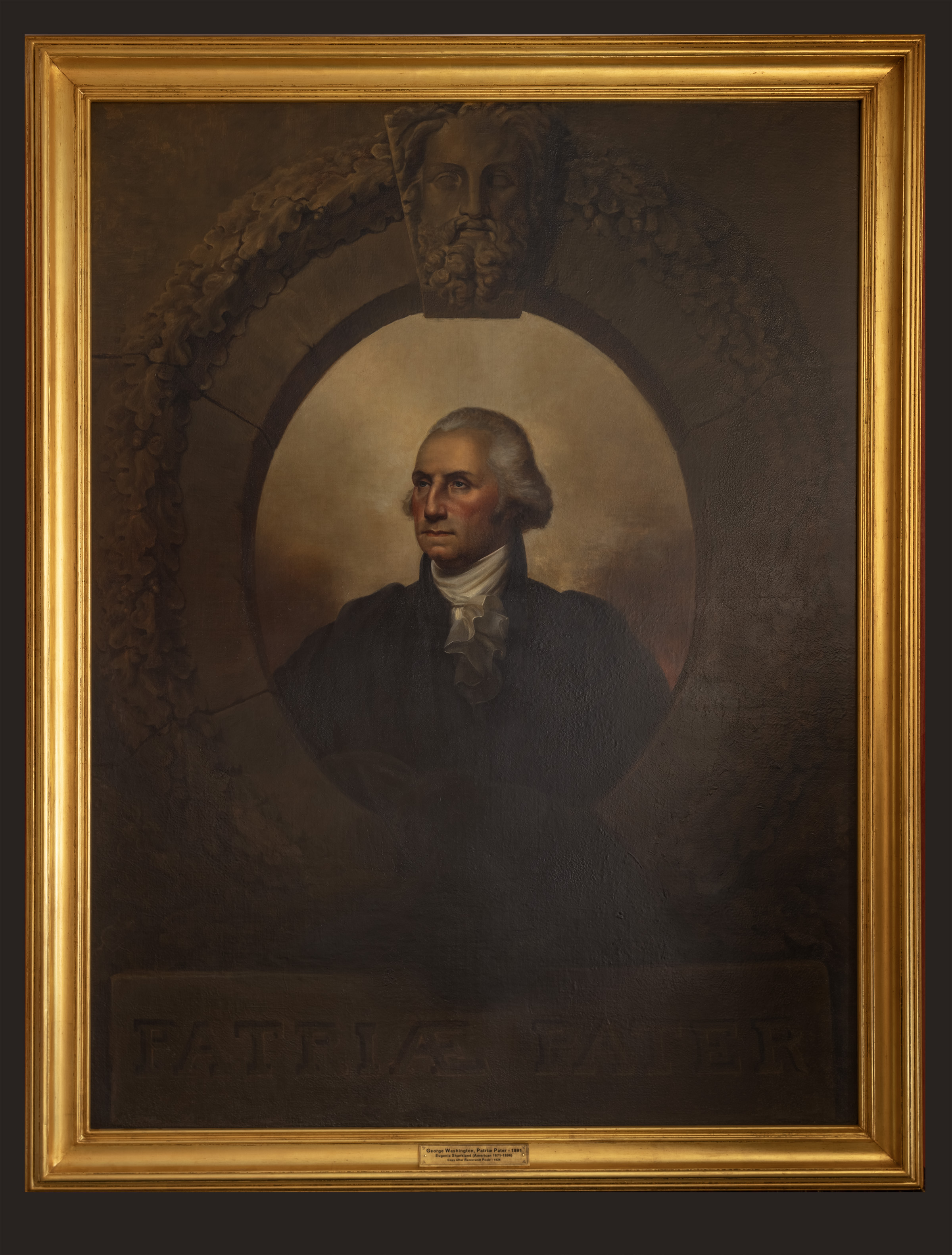
Eugenia Shankland (American 1871 - 1896) George Washington Patriae Pater - 1891, Copy After Rembrandt Peale 1824
Oil on canvas, 69 x 52 inches / signed verso
Before reading further, take a moment with this painting — notice what it stirs in you.
Interested in this painting? Call 724-459-0612
Click image to zoom
- Available for purchase
- Only one exists
- Competitively Priced $80,000

Loading testimonials…

- Available for purchase
- Only one exists
- Competitively Priced $80,000
Eugenia (Miss Genie) Shankland was once described as a beautiful child with dark eyes, pale intellectual face, and dark curly hair, whose face as a mature woman, retained all the amiable and sweet countenance of the little artist girl -- a child who, as a teenager, would become most famous for her portraits of George Washington. [3]
Eugenia Shankland was born in Washington, D. C. circa 1871. The eldest daughter of Manning R. Shankland, who had come to Washington from Philadelphia c. 1860 with John W. Forney, then a member of the House. Forney appointed Shankland to a clerkship and when Forney became secretary of the Senate, Mr. Shankland was given an appointment in the Senate secretary’s office, a position he held until his death in 1896. [1, 2]
As a child, Eugenia, although lame, played around the capitol grounds and made sketches. She also liked studying the paintings in the Capitol. However, it was Rembrandt Peale’s portrait of George Wasington, that hung in the Vice President’s room at the Capitol that fascinated her the most. She would later say that “I often wish I could have known the artist who conceived that idea of Washington. Studying it so continually I have become very fond of that head. To me it has such a dignity, such power and withal such tenderness as no other picture of Washington reveals. The mouth is the most powerful feature to me.” [3, 4]
The Shanklands lived near the capitol and near Senator Ingalls (Senate Pro Tempore, 1887-91). Eugenia presented the Senator with a pen-and-ink sketch of his daughter and they became friends. Circa 1891 after a bit of wrangling with her parents, they allowed her to take art study at the Corcoran Art Gallery. She was found to be gifted and after only four months was put into the life class. She studied there for only another two months. [3, 5]
Visitors to the Corcoran gallery would see the young student diligently at work at her easel copying paintings. Judge Watson of Brooklyn, New York was visiting, saw her at work and bought a painting – her first sale! And she continued to make sales from her copies. However, the lure of Peale’s Wasington persisted and Eugenia so wished to be able paint a copy of it. The painting was so fragile that it could not be taken down from the wall – It was badly cracked and was peeling from the canvas. So, her new friend, Senator Ingalls, in the Vice-President’s absence, allowed her to set up her easel and paints in his office. When the Vice-President returned, he allowed her to continue to paint there. [3, 4]
Originally, it was Eugenia’s intent to make a copy only for herself; however, her presence and what she was doing soon came to the notice of visitors. Senator Stockbridge (Michigan) bought it before it was completed; Senator Edmunds (Vermont) and Sergeant-at-Arms of the Senate Colonel Valentine (Nebraska) wanted a copy too. Vice-President Morton also wanted a copy. Apparently, they wanted a copy before the original painting was too far gone. [3, 4]
Eugenia had wanted to go to Europe for study; instead, she spent all that summer making copies of Washington, but not unhappily. The young artist was known around Washington and older artists who privately recognized her genius for portraiture and color had advised her to “wait until her own individuality is developed thoroughly before going abroad to study.” Nevertheless, Vice President Morton sent her to genre painter Daniel Huntington in New York City for study. She was only there for a short time before Huntington sent her home, saying that her “genius for color” required no teaching and that it was practice, not instruction, that she needed. [3, 4]
Prior to Eugenia’s copy, Peale’s Portrait of Washington had not been known to have been reproduced. Her 1891 copies were smaller versions that did not include the face of Homer and cut off everything outside of the inner ring of masonry. It was the sad condition of the original Peale that prompted Eugenia to undertake making a copy of the entire original painting including the circle of masonry, the oak wreath, and Homer’s head on the keystone. Working in her studio in the Maltby Building (Senate Annex) near the Capitol, she completed the full-scale version and it was placed on display in the Capitol. Her version could have passed for the original Peale and it was suggested that it replace the aging, deteriorating original. In 1894, she said of her effort, “What took Peale eight years to accomplish I reproduced in half that number of weeks!” [1, 3, 4]
Her copy did not replace the original Peale, however. Senator Voorhees, who had been an admirer of the original, introduced a bill providing for the purchase of Eugenia’s copy to hang in the new national library building. Senator Kyle proposed appropriating $1,500 for its purchase, but the bill was amended to $1,000. and the librarian of congress was directed to place it in a suitable part of the new library building. [4, 6]
Circa 1891, at the age of nineteen, after the completion of the full-scale copy of Washington, Eugenia converted to Catholicism, and expressed her desire to become a nun. Understandably, many were opposed to this decision, as they considered it a waste of her intellect and artistic genius. Further, she had gained acclaim and financial independence and almost assuredly would have had a successful career ahead of her. Up until the time Eugenia began her religious instruction at the Georgetown Convent; she had continued to paint – altar pieces for Washington area churches and elsewhere. That was in addition to her portraiture and figure work. In 1894 she completed a six-foot square painting of “Louis Quartorze” in full court dress with “clever coloring done in the half tones of an ancient tapestry”. Her uncle in Philadelphia bought it for his library. She was no mere copyist; there was the nuance of the intellectual in her works. [1, 7, 8]
Circa 1895/96 she “retired from the world” when she left Washington, D. C. to enter the convent of the Sisters of Visitation in Wilmington, Delaware. She was one of the youngest members of the order and was also one of the strictest in her observances of the duties required. Never very strong, her superiors recognized her physical weakness, and attempted to relax their strict rules in order to alleviate some of her suffering. Eugenia may have been weak in body, but she was strong in will and insisted in performing the tasks as required by the order. [7, 9, 10,]
Sister Angelica, the name Eugenia had taken when she entered the novitiate, died in the winter of 1896, only a short time after entering the convent. She had become very ill prior to completing her novitiate and prior to her death. The order realizing she was beyond their earthly ministrations and recognizing her devotion, advanced her into full membership. She died having achieved her aspiration to become a nun. [7, 11]
Eugenia Shankland (Sister Angelica) was only twenty-five when she died. She had spent more years of her short life as an artist than as a nun. In 1894, she recognized that her paintings of George Washington had made her fortune. At that time, the full-scale version of Peale’s Washington was still in her studio which she looked upon with great pride. At the same time, an observant visitor would have noticed that beside Washington was a painting of Christ on her easel; forecasting her path from worldly pride, money and fame to the rewards of the spiritual realm. [4,7]
Written by Joan Hawk, Researcher and Co-Owner Bedford Fine Art Gallery, February 06, 2026.
Use only with the permission of Bedford Fine Art Gallery.
References:
- https://newspaperarchive.com/washington-morning-times-mar-09-1896-p-6/ (accessed 02/01/2026).
- https://www.kansashistory.gov/kansapedia/john-james-ingalls/12095 (accessed 02/01/2026).
- https://newspaperarchive.com/boston-sunday-globe-feb-18-1894-p-23/ (accessed 02/01/2026).
- https://newspaperarchive.com/philadelphia-inquirer-feb-19-1894-p-5/ (accessed 02/01/2026).
- https://newspaperarcive.com/the-sunday-herald-and-weekly-national-intelligencer-jan-11-1891-p-13/ (accessed 02/01/2026).
- https://newspaperarchive,com/washington-times-aug-03-1894-p-3/ (accessed 02/01/2026).
- 7/4. Washington Post (1877-1922); Jan 1, 1897; ProQuest Historical Newspapers: The Washington Post, pg. 9.
- https://newspaperarchive.com/philadelphia-times-dec-07-1894-p-5/ (accessed 02/01/2026).
- Curtis, Georgina Pell, 1911, The American Catholic’s Who’s Who, p. 594, The Catholic World, New York. (accessed 02/01/2026).
- https://newspaperarchive.com/cincinnati-catholic-telegraph-apr-09-1896-p-4/ (accessed 02/01/2026).
- https://newspaperarchive.com/philadelphia -times-dec-23-1896-p-11 (accessed 02/01/2026).