
A Historical Analysis & Archival Review
The 19th-century American landscape functioned as both an artistic subject and an evolving frontier that demanded careful documentation. Among the prominent figures of the Hudson River School, Frank Anderson (1844–1891) distinguished himself through a steadfast commitment to topographical accuracy. Ongoing research by Bedford Fine Art Gallery demonstrates that Anderson’s analytical methodology, combined with his mastery of Luminism, enabled him to document the New York landscape with exceptional precision.
The Analytical Mind: An Inventor’s Approach to Painting
Frank Anderson’s artistic approach was fundamentally influenced by an environment of innovation. Born in Ohio in 1844 and later relocating to the East, Anderson inherited a technical aptitude from his father, who was an inventor. Anderson himself demonstrated inventiveness, notably by conceptualizing improvements to the telegraph system of his era. This mechanical and problem-solving orientation is essential for understanding his body of work. As Anderson transitioned from sketching and watercolor in his youth to oil painting, he maintained his empirical sensibility, applying the precision of telegraphic engineering to his rigorous topographical observations of the natural world.
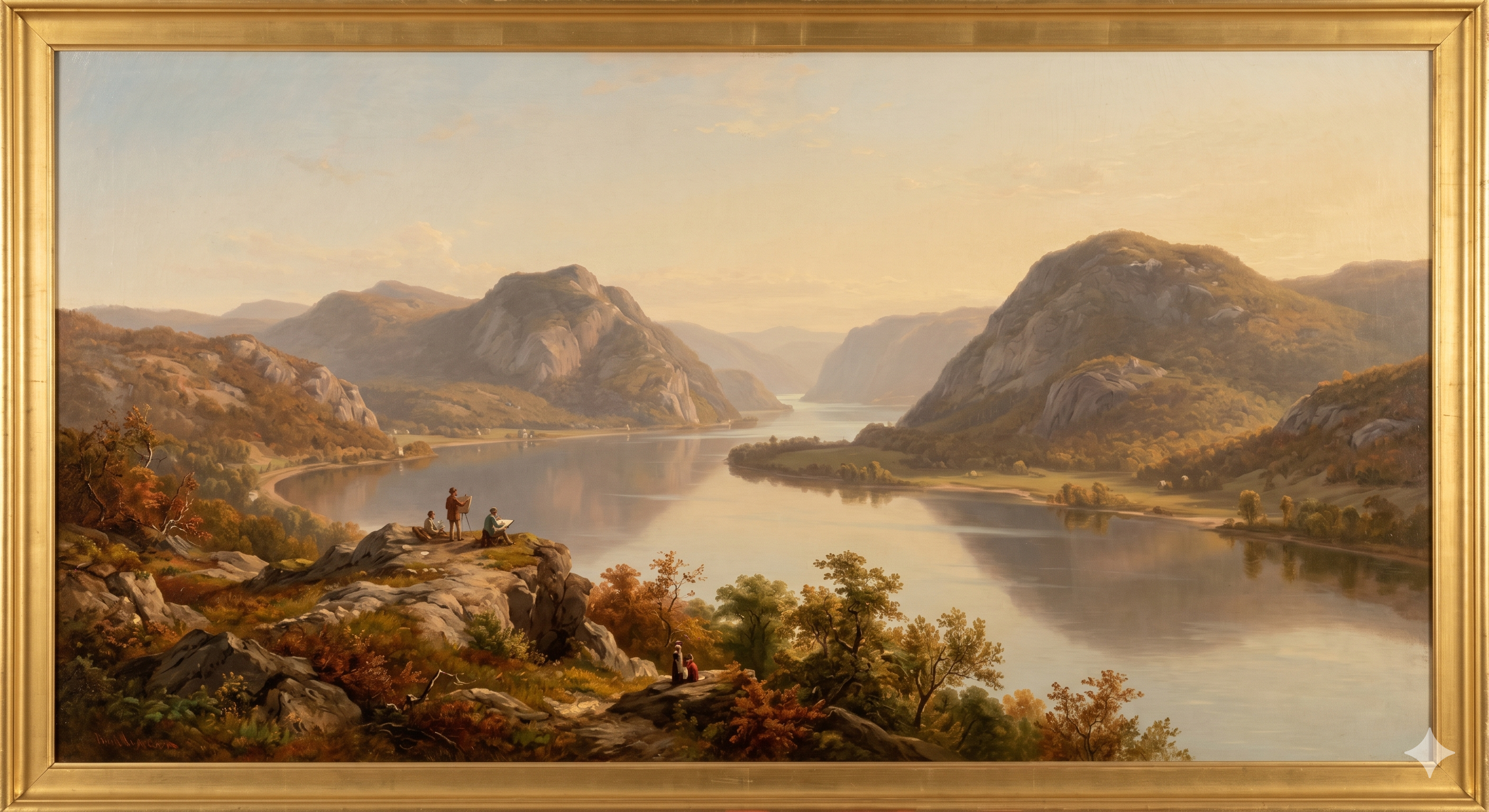
After relocating to Peekskill, New York at the age of eighteen, Anderson gained direct access to the varied and dramatic topography of the Hudson River Valley. In contrast to contemporaries who often produced highly romanticized or synthesized depictions of nature, Anderson’s landscapes are recognized for their locational fidelity. His works function as tangible records of the physical realities of 19th-century New York.
Archival Note: Historical auction records and gallery archives frequently record Anderson's use of specific locational titles, such as Falls on Popolopen Creek Near Peekskill (1863), Hessian Lake (1878), and Lake George (1867). These precise designations indicate a deliberate intention to document identifiable geographic sites rather than generalized or abstracted landscapes.
Luminism and the Poetry of the Empirical
Although Anderson’s draftsmanship was consistently precise, his treatment of light elevated his topographical studies into the domain of Luminism. Luminist painters within the Hudson River School are distinguished by their focus on the effects of light on water and sky, frequently employing restrained brushwork to achieve a smooth, glass-like surface that minimizes evidence of the artist’s hand. Anderson excelled in this visual language, enveloping his meticulously rendered landscapes in a "resonant quietude" and utilizing atmospheric effects of seasonal light to evoke mood while maintaining geographical accuracy.
Anderson’s autumnal landscapes from the 1880s, including Gathering Leaves (1883) and Evening (1885), exemplify this synthesis. The precise depiction of tree lines and geological formations of the Hudson River inlets situates the viewer within a specific locale, while the pervasive, luminous light encourages a contemplative engagement with the scene.
Exhibition History and Scholarly Legacy
Despite a documented shyness that kept him removed from the highly social circles of the New York art establishment, Anderson’s empirical rigor and aesthetic mastery earned him critical recognition. From 1861 to 1888, his work was consistently exhibited at premier institutions, most notably the Pennsylvania Academy of the Fine Arts and the National Academy of Design. Today, his pieces form crucial components of institutional collections, including the Adirondack Museum and the Hudson River Museum.
For historians and art scholars, Anderson represents the vital intersection of 19th-century industrial-era pragmatism and Romantic landscape painting. His paintings are not merely aesthetic objects; they are environmental records of the Hudson River Valley before the acceleration of modern development.
Bedford Fine Art Gallery's Commitment
Bedford Fine Art Gallery maintains a rigorous, research-driven commitment to preserving the legacy of Hudson River School artists who integrated empirical documentation with fine art. Frank Anderson’s detailed topographical records of New York’s waterways and rural areas are central to this historical narrative. Through ongoing acquisition, study, and exhibition of his work, the gallery serves as a valuable resource for scholars examining the geographical and artistic development of the 19th-century American landscape.