
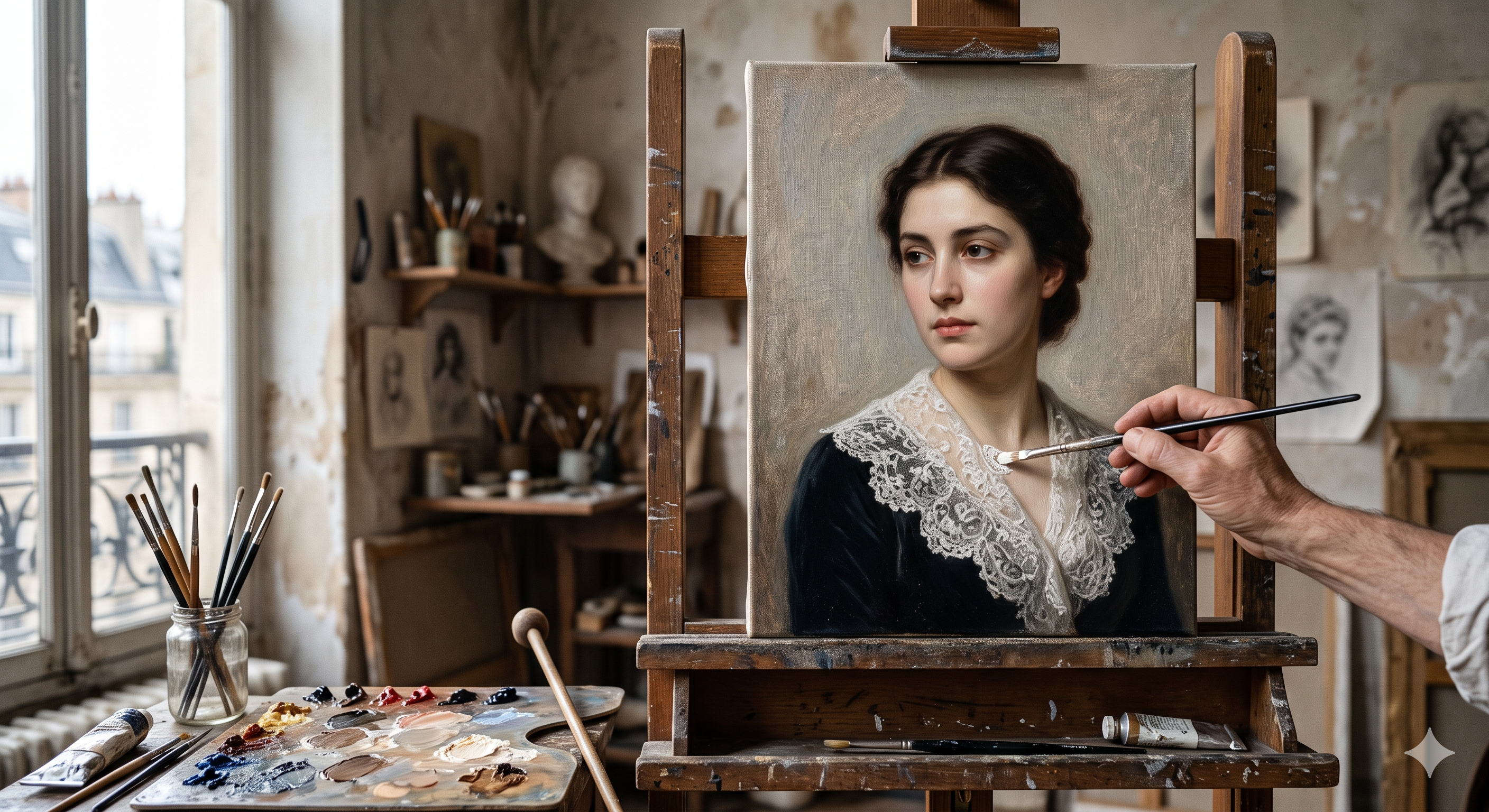
Within the competitive landscape of the 19th-century French art world, the Paris Salon exerted significant influence. This institution served as the primary venue for artists to establish their reputations, receive critical evaluation, and attract the attention of prominent collectors. Jules-Frédéric Ballavoine (1842–1914) was among the artists who consistently succeeded in this demanding environment. As a technically trained draftsman and graduate of the École des Beaux-Arts, Ballavoine’s career provides a valuable case study in the techniques and conventions of French Academic portraiture.
The Foundation of Academic Training
Ballavoine’s technical proficiency originated from his formal education under Isidore Alexandre Augustin Pils, a distinguished historical painter. The École des Beaux-Arts curriculum during this period prioritized dessin (drawing) as the foundational skill. Students were required to spend several years mastering the structure of the human form, the principles of light and shadow, and the intricacies of human anatomy before progressing to painting.
This emphasis is evident in Ballavoine’s oeuvre. His portraiture demonstrates intellectual and structural rigor, featuring the "near-invisible" brushwork and precise modeling characteristic of contemporaries such as Jean-Auguste-Dominique Ingres. In these works, silhouettes are sharply defined, anatomical features are rendered with accuracy, and transitions of value across facial planes are executed with a smoothness that imparts a tactile quality to the painted surface.
The Salon and Technical Execution
Ballavoine commenced exhibiting at the Paris Salon in 1865 and maintained a consistent presence for several decades. His sustained success at the Salon can be attributed to his capacity to integrate technical mastery with the prevailing aesthetic standards of the period.
Academic portraiture extended beyond achieving a faithful likeness; it served as a demonstration of the artist’s command of the medium. Ballavoine’s portraits frequently exemplify a disciplined approach to composition:
- Modeling and Chiaroscuro: Ballavoine employed a sophisticated range of mid-tones to create a sense of volume. Through precise control of gradations from light to shadow, he imparted his subjects with a physical presence that appeared to emerge from the canvas.
- Textural Contrast: Ballavoine frequently juxtaposed the soft, ethereal treatment of skin tones with meticulous, highly detailed renderings of clothing, lace, and jewelry. This interplay between organic elements, such as human skin, and inorganic materials, such as fabric, became a hallmark of his technical proficiency.
- Harmonious Color Theory: Ballavoine’s use of color was deliberate, often relying on a controlled palette to guide the viewer’s gaze through the composition. Cool blues and neutral dark backgrounds were frequently utilized to accentuate the warmth of a subject’s features or hair.
The Lasting Significance of the Academic Method
Although the late 19th century witnessed the emergence of Impressionism, which challenged the dominance of the École, the Academic tradition remained a standard of professional excellence. Ballavoine’s work serves as a bridge between the rigorous classical training of the early century and the evolving market demands of the Belle Époque.
Ballavoine’s paintings are significant not only for their aesthetic qualities but also as artifacts of a distinct pedagogical evolution. These works demonstrate that the "poetry of life," a phrase frequently associated with his art, was grounded in rigorous technical skill. Each brushstroke in a Ballavoine portrait represents a deliberate decision, reflecting a craft honed through years of academic discipline.
In the ongoing analysis of 19th-century portraiture, Ballavoine stands as a testament to the endurance and efficacy of the Academic method, offering critical insight into the standards that shaped an entire generation of French artists.