
Nineteenth-century American art was predominantly shaped by male artists, especially within the renowned circles of the Hudson River School. However, beyond the extensively documented achievements of figures such as Thomas Cole and Frederic Edwin Church, the significant yet frequently overlooked contributions of female artists played a crucial role in the movement's later development.
Olive Parker Black (1868–1948) stands among the most accomplished of these painters. Her rigorous academic training and extensive exhibition record not only established her professional success but also resulted in a substantial archival legacy that offers critical insight into the professionalization of female artists during the Victorian era.
Forging a Path: Academic Pedigree
Born in Cambridge, Massachusetts, in 1868, Olive Parker Black’s career was grounded in elite, formal instruction. Her professional trajectory illustrates the expanding, yet still restricted, opportunities available to women in the arts during the late Victorian period.
Black commenced her studies at the School of Painting at the Museum of Fine Arts in Boston, where she was instructed by Otto Grundmann and Frank Crowninshield. Her subsequent relocation to New York in the 1890s proved pivotal in the development of her distinctive style. In New York, she continued her education at the Art Students League and the National Academy of Design.
Her mentors read like a directory of late-19th-century American masters:
- William Merritt Chase: Under Chase's instruction, where she was often recognized as his premier student, Black mastered the en plein air (outdoor) techniques of the Impressionists and likely attended his renowned Shinnecock Summer School of Art on Long Island.
- Hugh Bolton Jones: Under Jones's guidance, Black adopted the Barbizon style, incorporating subtle, harmonious tonal qualities and loose brushwork that characterize her most acclaimed works.
- Edwin Blashfield: At the National Academy, Blashfield contributed to the refinement of Black's technical precision and structural composition.
The Late Hudson River School and Tonalist Transitions
Black is primarily recognized for her landscapes depicting the Northeastern United States, ranging from Maryland to the Berkshire Mountains of western Massachusetts, where she maintained a summer residence in South Egremont.
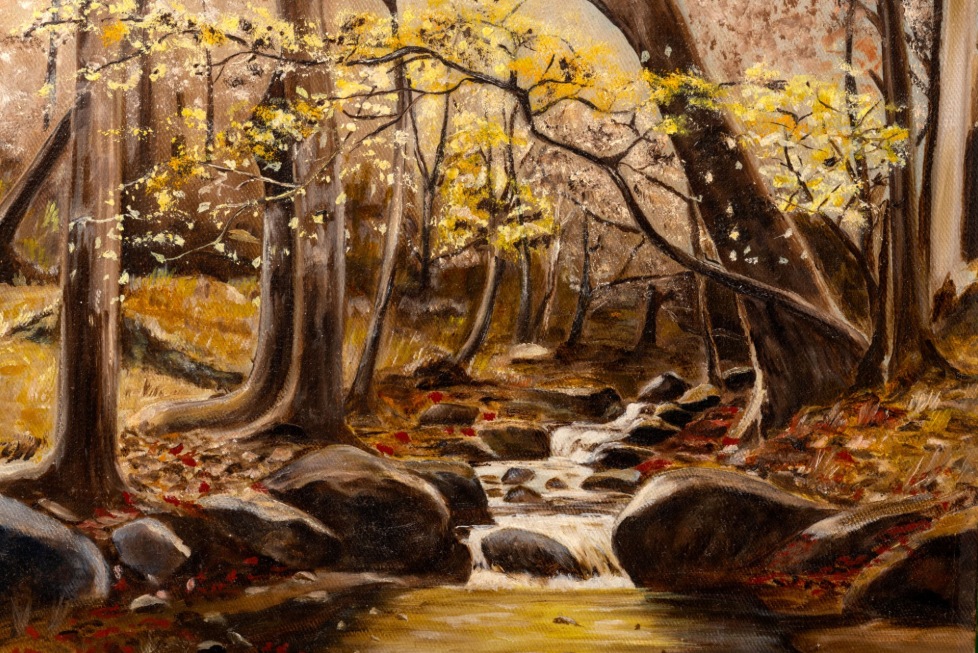
Her work holds historical significance as it bridges the aesthetic divide between the sweeping, romantic grandeur of the Hudson River School and the more intimate, atmospheric approaches of Barbizon Tonalism and American Impressionism. Archival documentation, including her pastoral scenes with weaving streams, tranquil reflections, and lush foliage, demonstrates her mastery in capturing seasonal and temporal nuances. Unlike the monumental, untamed wilderness favored by early Hudson River painters, Black's landscapes frequently depict quiet, cultivated nature, which is characteristic of the late nineteenth-century transition.
Archival Footprint: Exhibitions and Memberships
For art historians and collectors, an artist's exhibition record often serves as a primary indicator of their impact during the Victorian era. Black’s archival presence is notably extensive for a woman of her time. She played an active role in establishing institutional support systems for female artists.
She was a prominent member of several leading organizations:
- National Association of Women Artists
- The Copley Society in Boston (formerly the Boston Art Students Association)
- American Artists Professional League
- New York Society of Painters
Archival exhibition catalogs further confirm that Black received consistent recognition from both peers and critics. She exhibited at the National Academy of Design for more than three decades (1897 to 1930). Her paintings were also selected for display at the Pennsylvania Academy of the Fine Arts, the Carnegie Institute, and the Boston Art Club.
Collecting Olive Parker Black at Bedford Fine Art Gallery
Today, the archival preservation of late Hudson River School artists depends significantly on specialized galleries and dedicated collectors. At Bedford Fine Art Gallery, we remain committed to the research, conservation, and acquisition of original nineteenth-century Victorian artworks, including the landscapes of Olive Parker Black.
The gallery actively curates works that highlight Black's mastery of atmospheric effects and her distinctive synthesis of Hudson River School techniques with Impressionist brushwork. The collection has included notable works by Black, such as exemplary representations of her woodland streams and pastoral reflections.
For those interested in acquiring a professionally conserved work by Olive Parker Black or in selling a historically significant Victorian painting, Bedford Fine Art Gallery offers expert guidance grounded in rigorous historical research and a commitment to nineteenth-century American art.