
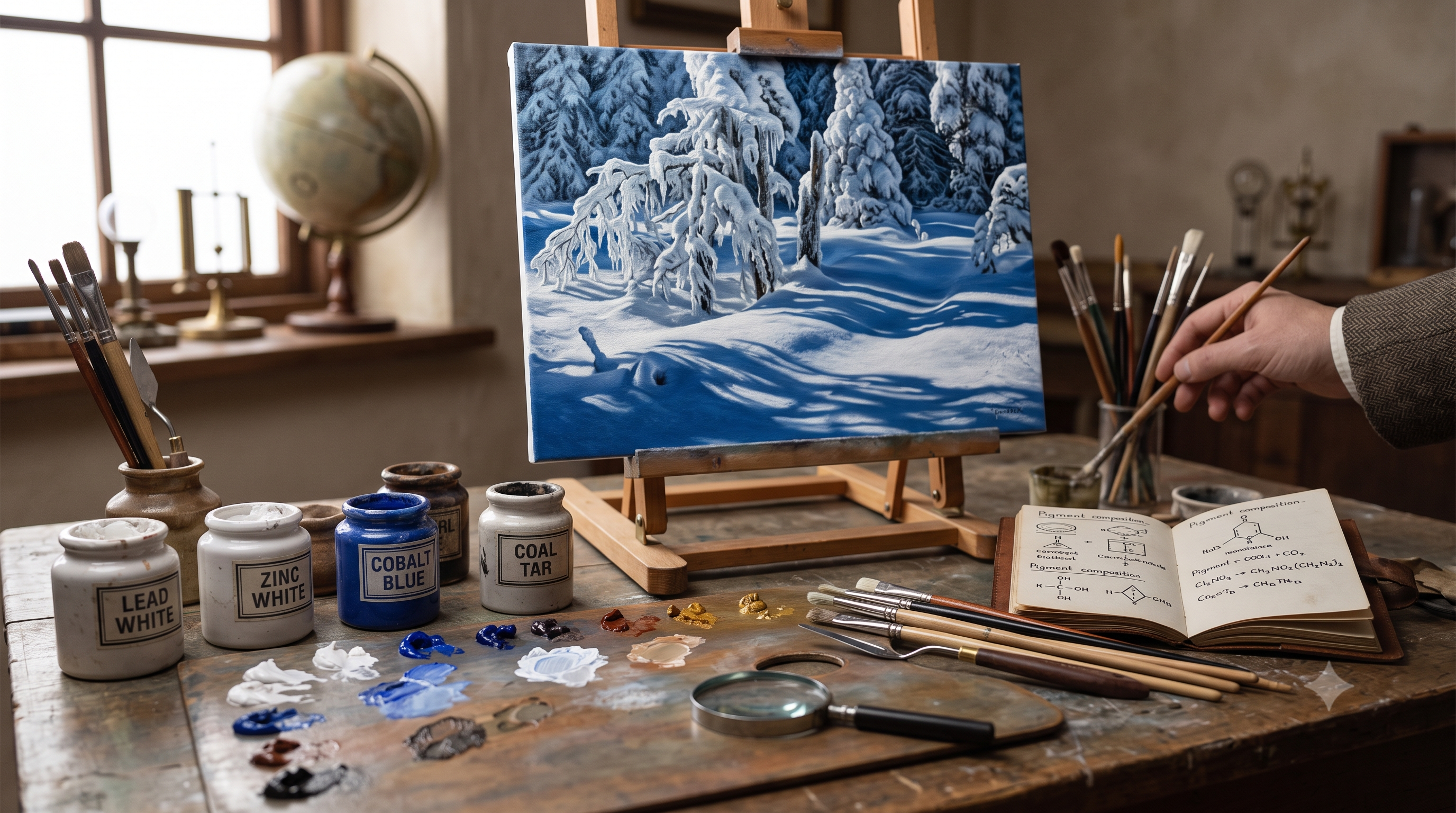
William Bliss Baker (1859–1886) is recognized as one of the most accomplished, though short-lived, artists of the late Hudson River School. Prior to his death from an ice-skating accident at the age of 27, Baker demonstrated exceptional mastery of naturalistic detail. Although he is widely known for his masterpiece Fallen Monarchs, his winter landscapes—such as Morning After the Snow (1885) and First Snow of Winter (1884)—most clearly exemplify how his hyper-realism bridges artistic expression and empirical observation. Achieving this degree of precision required not only artistic skill but also a sophisticated understanding of the material science underlying 19th-century oil painting.
The Optical Challenge of Snow and Ice
Physically, snow is not simply a flat white surface. It consists of a highly porous matrix of ice crystals that produces complex optical phenomena, such as subsurface scattering, specular highlighting, and diffuse reflection. When light enters a snowpack, it scatters among microscopic ice facets before reflecting back to the observer, absorbing warmer wavelengths and resulting in the cool, bluish shadows characteristic of winter.
To represent these optical effects on a two-dimensional canvas, an artist must replicate the underlying physical phenomena using available materials. Baker’s approach to painting snow involved manipulating the refractive indices of various pigments and oil binders to simulate the behavior of crystalline water under directional sunlight.
The Chemistry of the 19th-Century Palette
Baker’s capacity to depict the weight, crust, and powdery qualities of snow was fundamentally linked to the chemical properties of his pigments. In the 1880s, landscape painters employed a specific range of white pigments, each with distinct structural characteristics:
- Lead White (Flake White): Composed of basic lead carbonate, lead white served as the primary structural pigment in the 19th-century palette. It dries rapidly into a durable, flexible film and has a high refractive index, resulting in strong opacity. Baker exploited the rheological properties—specifically, the thickness and flow—of lead white to create physical impasto. By applying thick layers of paint, the textured surface of the brushstrokes captured ambient light, effectively replicating the rough, scattering surface of packed snow.
- Zinc White (Chinese White): Composed of zinc oxide, this pigment became widely available to oil painters by the mid-19th century. In contrast to lead white, zinc white exhibits a cooler color temperature and is highly semi-transparent. Baker used zinc white in thin, overlapping glazes to convey the translucent, brittle quality of sheer ice and the delicate frost on dormant branches.
By combining the dense, opaque qualities of lead white with the transparent, cool glazes of zinc white, Baker effectively recreated the physical density of a winter landscape.
Viscosity, Scumbling, and Subsurface Scattering
Beyond pigment selection, the realism in Baker’s winter scenes depended on the precise viscosity of his oil mediums, typically cold-pressed linseed or walnut oil.
To replicate the optical effect of subsurface scattering in snow, Baker used a technique called scumbling. This process involves dragging a stiff, semi-opaque layer of light paint over a darker, dried underpainting. The partially transparent medium allows the dark under-layer to absorb some light, while the scumbled white layer reflects the remainder. This precise layering of oil and pigment creates an optical illusion that closely matches the wavelength absorption occurring when light penetrates a deep snowdrift.
To depict the deep blue shadows cast by barren trees on snow, Baker avoided mixing black and white. Instead, he utilized the transparent properties of ultramarine or cobalt pigments. By glazing a thin layer of blue over a cured layer of lead white, the white ground reflected light back through the blue pigment, producing a luminous internal glow similar to the effect of ambient skylight within a frozen shadow.
A Legacy of Empirical Realism
William Bliss Baker’s winter landscapes represent a significant achievement in technical execution. His work exemplifies the intersection of naturalism and the chemical advancement of artist materials during his era. Through a comprehensive understanding and manipulation of specific gravities, refractive indices, and drying times of his pigments, Baker did not merely depict the appearance of snow and ice; he engineered their optical equivalents on canvas.